UK Residential Land Planning
April 2026
In our series on Ashen Capital’s (“Ashen”) investment strategies, we explore why Ashen is investing heavily in the “Residential Land Planning” sector (“RLP”), being where land is taken through the planning system and then sold with consent to a “Housebuilder”, who builds out the homes. We explain why this strategy is seen as a more robust investment proposition in an uncertain world.
Ashen’s primary focus is to invest into real estate businesses who have deep sector specialisms and ability to execute, providing capital and expertise to maximise their potential. For RLP, Ashen is investing directly into suitable projects via its corporate partner Merrow Wood.
So why does Ashen like the Residential Land Planning sector? This is because of:
- Demographic growth and a historic delivery undersupply;
- A more permissive planning policy environment;
- Attractive risk-adjusted financial returns; and
- The lower volatility of residential values versus commercial real estate in a market downturn.¹
Firstly, the Labour Government’s manifesto pledge in 2023 to deliver 1.5 million new homes in England over the current parliamentary term (c. 300k pa) is a direct attempt to address the need for new quality housing, caused by demographics (population growth, smaller households and an aging population) and to reverse a period of significant under delivery.
The chart below illustrates the extent of this shortfall, with the target last being delivered nearly 60 years ago, during a period where local authorities were typically building around 40% of all new homes. Over the last 20 years the average has been closer to 150k pa.
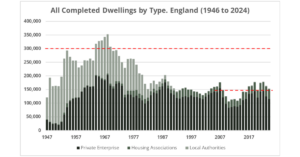
Source: Ministry of Housing
Secondly, to accelerate delivery of housing, during the last two years the planning environment has become more supportive of residential development, particularly through amendments to the National Planning Policy Framework (“NPPF”) and reinstatement of housing delivery targets.
A notable introduction to the revised NPPF was the was the formal recognition of “grey belt” land – intended to be underutilised or lower-quality segments of the Green Belt that does not contribute strongly to the purposes of the Green Belt and to confirm that the Green Belt is to stop coalescence of “towns”, not “villages”.
The consequence of this provision means that provided there is a demonstrable need for more housing (i.e. not able to identify a five-year housing supply), that the development is in a sustainable location and the development satisfies the Golden Rules (being broadly a 50% affordable housing provision), then development should be permitted.
Thirdly, the planning system can produce an attractive capital return from a changing a sites fundamental attributes regardless of market trends. The profit available through changing sites use class, from farmland with say £5,200 per acre on average² to land with a residential consent, at over £1.25m per acre³ outweighs any potential fall in residential land values from market cycles. Whilst there is downside risk that costs incurred are lost if planning is not achieved, this can be mitigated through owning a portfolio of land assets where any planning failure on one is offset by successes elsewhere.
Finally, in the face of an uncertain geopolitical backdrop, residential assets have proven in the past to have lower downside risk that commercial real estate or other financial assets. Over the course of the financial year 2008–09, the FTSE all-share index fell by c 33%, UK commercial real estate by c 25%, while the average house prices fell by c. 15 per cent.
Given current global events, which has caused uncertainty on interest rate movements, cost inflation and the wider economic health of the UK, Residential Land Planning provides an attractive market for investors to make capital returns. While housebuilders could reduce their appetite to buy land, they have well-established operational models for managing costs, maintaining low levels of land inventory with consistent latent demand for build housing.
In conclusion, whilst there is uncertainty in the current global economy, Ashen remains active in the residential sector given the long-term demographic tailwinds, the more permissive planning environment and the ability for the planning process to create value.
Ashen is deploying its capital into the Residential Land Planning sector and aims to increase this in the year ahead.
¹ Source: Property Industry Alliance Report 2023
² Source: Savills 2025
³ Source: UK Parliament Report 2018
Disclaimer: The views and opinions expressed herein are for informational purposes only and do not constitute professional advice. They should not be relied upon as a substitute for consultation with qualified professionals. No representation or warranty is made as to the accuracy, completeness, or suitability of any information provided. The author(s) disclaim any liability for decisions made or actions taken based on the content of this material.