Real Estate Senior Lending
May 2026
Introduction
Ashen Capital has invested into Sibner Investment Management, a residential construction and bridge lending platform, as we believe that this provides one of the most attractive risk adjusted returns available to us.
Executive Summary
The case for investment into UK residential is compelling because we are not building sufficient numbers of new homes to meet demand, and house prices (in real terms) have been broadly static in a generation.
These dynamics provide an attractive entry point to the sector, which is sustained by the liquidity and ubiquity of the asset class.
This article will demonstrate these points, but will also explain why real estate lending to support the construction of smaller scale developments for sale, may give investors the most compelling way of capturing the opportunity.
The Market
We are building around 200k new units per annum, against a population that has grown by 500k per annum. However, despite the pressure of population growth, housebuilding in the UK is nearing a 14-year low, with 26,959 new homes registered in the first quarter of 2026, marking a 6% decrease from last year (source: The National House Building Council 2026).
UK Housing Delivery
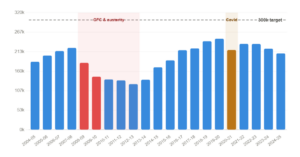
Source: MHCLG Housing Supply Statistics (net additional dwellings, England).
Figures include new build completions, conversions and changes of use, minus demolitions.
UK Housing Supply
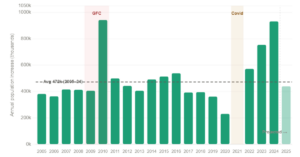
Sources: ONS mid-year population estimates (2010–2024, UK);
ONS 2024-based national population projections (2025–2030).
UK House Prices

Sources: ONS/HM Land Registry UK House Price Index (annual average prices); ONS CPI index for deflation.
Real prices expressed in 2005 pounds. 2025 = average of available monthly data to Q3 2025.
The shortage over the last twenty years has supported the growth in house prices (shown in blue here), with house prices nearly doubling in nominal terms. However, once adjusted for inflation (shown in green below), the growth in house prices is minimal, less than 1% per annum.
In 2025, real prices remained well below their 2022 peak and with 2026 set to have an inflationary shock from the conflict with Iran, real prices may well fall further. In short, in real terms houses prices today are no more expensive than they were pre-GFC, and this pricing is underpinned by a continuing and fundamental supply and demand imbalance.
Why Construction Loans for SME Residential Developers
While much attention is directed at large national housebuilders, it is small and medium-sized (SME) residential developers who quietly form the backbone of local housing delivery — despite being consistently underserved by mainstream lenders. Providing construction loans to this sector, with loan-to-value (LTV) ratios up to 70% and loan sizes up to £5 million, represents not just a sound commercial opportunity, but a genuinely impactful one as it enables housing delivery.
High street banks retreated significantly from development lending following the 2008 financial crisis and have never fully returned. The operational complexity and regulatory capital requirements have made smaller, bespoke construction loans unattractive to institutions, who are built for scale.
SME developers, i.e. those building anywhere from 2 to 30 units per scheme, are routinely turned away or subjected to unworkable terms. This funding gap is well documented and creates an open field for specialist lenders willing to engage with this borrower profile on practical terms.
SME developers who find a reliable lending partner tend to stay loyal. A lender that moves quickly, understands planning nuance, and offers transparent terms becomes an essential part of a developer’s funding toolkit. This creates a natural pipeline of repeat business, referrals, and long-term relationships, the kind of sticky, relationship-led book that generates consistent returns without the churn of purely transactional lending.
Why senior secured loans below £5 million
Construction debt finance of up to around 70% LTGDV and 90% LTC provides a substantial equity buffer against cost overruns, market softening, or delayed sales. It is a disciplined position that protects the lender without excluding creditworthy but smaller borrowers. Loans up to £5 million align precisely with the SME developer’s typical project footprint: a conversion of a Victorian office into apartments, a small new-build scheme on an infill site, or a terrace of family homes in a southeast commuter town. These projects are often too large for high net worth backed bridging lenders and too small for institutionally funded development finance. By serving this middle ground, a lender can build a diversified portfolio of granular loans across multiple geographies and asset types — reducing concentration risk while maintaining healthy margins.
The use of technology is key to enabling a loan book of smaller ticket loans to be scaled effectively. It is worth keeping to a pool of smaller loan sizes, as they also tend to complete and repay faster, improving capital velocity and liquidity. Completed residential units, priced for the mass market, rarely sit unsold for long in well-chosen locations, which means exit risk, the primary concern in construction lending, is well managed when underwriting is disciplined.
These loans also tend to be priced attractively, with fixed annual interest rates of more than 12%. Loans also typically benefit from a personal or corporate guarantee from the borrower, which can be insured with a third party, ensuring that the upside is attractive and the downside secure.
How to Access this Market
Ashen have invested into this market segment through an open-ended fund managed by Sibner Investment Management. It is one of Ashen’s anchor strategies due to the outsized risk adjusted returns available. It also fits the social mandate for Ashen, as it helps deliver much needed family housing.
Further details on Sibner and the fund can be found at www.sibner-invest.co.uk
Disclaimer: The views and opinions expressed herein are for informational purposes only and do not constitute professional advice. They should not be relied upon as a substitute for consultation with qualified professionals. No representation or warranty is made as to the accuracy, completeness, or suitability of any information provided. The author(s) disclaim any liability for decisions made or actions taken based on the content of this material.